ENERGY AND ECOLOGY,
ENEKO - CENTER AND CENTER FOR
MULTIDISCIPLINARY STUDIES
BUDVA - MONTENEGRO
MILA
PUCAR, IGOR MARIC
ljpucar@ptt.yu
Institute
for Architecture and Urban Planning of Serbia
Bulevar revoluvije
73/II, 11000 Beograd, Yugoslavia
MILA
PUCAR, IGOR MARIC
ljpucar@ptt.yu
Institute
for Architecture and Urban Planning of Serbia
Bulevar revoluvije
73/II, 11000 Beograd, Yugoslavia
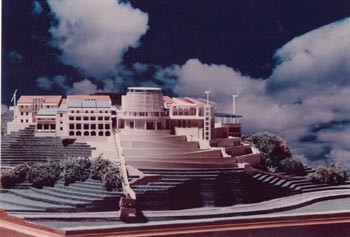
Inter-academy cooperation of the Serbian Academy of Sciences and Arts and the Montenegrin Academy of Sciences and Arts includes the Program for establishment and construction of the Mediterranean center for Energy and Ecology (ENEKO-CENTER). The same site will, in addition to ENEKO-CENTER complex, accommodate the facilities of the Center for Multidisciplinary Studies which should enable the implementation of joint programs and international cooperation of Yugoslav universities (Fig.1).
Planning studies which resulted in the ENEKO-CENTER Development Program in 1993 were, after procurement of agreements
and support by responsible federal and republican government authorities followed in 1996 with the development of the architectural concept and the general project of the ENEKO CENTER complex.
ENEKO CENTER in Budva - Becici is included in the Unesco's World Renewable Energy Network - WREN. Negotiations are under way to make the Center a UNIDO-s regional center and to join the program of the World Solar Summit. Initiatives are underway to create conditions which would allow the Center to become an institution of international character and to establish links with other relevant international organizations.
ACTIVITIES OF THE CENTER
The activities of the Center will cover initiation, programming, co-ordination and realization of different projects with the objective of rational production, transformation and use of energy in the context of environmental protection and improvement, including:
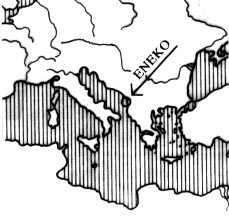
The primary objective of the initiative is the establishment and initial operation of the ENEKO CENTER, located in Becici - Montenegro (Fig.2), to conduct research, specialization, information and consulting activities on energy production and use as well as on related environmental problems, with a particular emphasis on marine environment with the aim of:
ARCHITECTUAL DESIGN CREDO
The design credo is to combine the building experiences from the past with the modern technological solutions, with the aim to research appropriate solutions for the future.
URBAN DESIGN CONCEPT
Dynamic micro-relief, steeply sloped terrain, traditionally planned villages of the rural Budva hinterland, and bio-climatic factors, have been the main points of departure in planning of ENEKO CENTER and the Center for Multidisciplinary Studies and Research, which are organically formed as a complex based on regional characteristics and bio-climatic principles in the use of natural sources of energy of the given location.
The terrain is extremely steep with the South, South East and South West exposure, and the altitude extent of 23-25 m (the level of the Adriatic highway on the South side of the terrain being 15m and the highest level of the terrain being 48-50m).
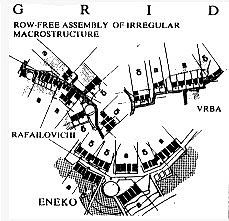
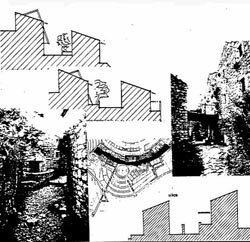
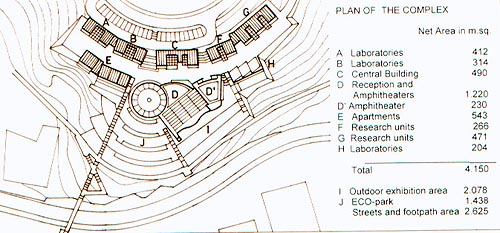
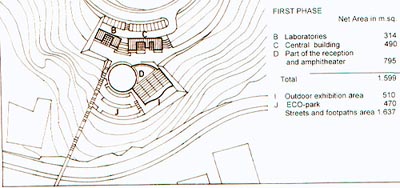
The organic approach is manifested in the location of the buildings on the terrain, with no greater interventions on it, resulting in the free matrix structure, based on a traditional module (of 6x6m), reminiscing Pastrovic settlements in the hinterland (Figs.3,4).
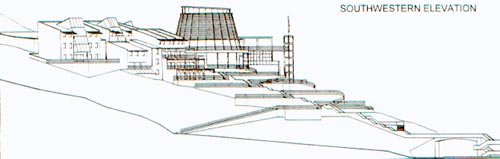
The buildings, with heights ranging from Ground+1+Mansard floors to Ground+2+Mansard floors, are oriented southwards and lined along the same level on the terrain, thus forming terraces in the spirit of traditional architecture. Special attention has been paid to spatial organisation of public - open, semi-public - fenced/walled , and private (working) - enclosed spaces, with the aim to create polysemantic ambience of interrelated functions.
On the basis of the analysis of natural, micro-climatic conditions, the whole complex is conceived on the principles of bio-climatic architecture, both the traditional ones and those based on the new contemporary research and technologies. The aim of such planning is to provide the best available autonomous energy supply for the buildings. Different solutions are planned, which will in the future exploitation, prove the initial theoretical research.
The vegetation constitutes an integral part of the planning solution, thereby exerting an impact on the micro-climate, protective of the negative impacts, as well as creating an energy balanced landscape in harmony with the Mediterranean ambience.
The planned
fragmented physical structure enables gradual construction of the Center,
thus reminiscing the building evolution of Pastrovic settlements.
ARCHITECTURALDESIGN CONCEPT
The architectural design concept of the ENEKO CENTER reflects its basic activities, which consist of development, research, new energy sources, new systems and technologies.
With regard to the planned activities which will be carried out in the ENEKO CENTER, the following groups of rooms are envisaged:
The basic
intention of the architectural design is to appropriately materialise the
Centre's programmatic contents and spirit. The urban design emphasises
the relevance of the Pastrovic building heritage as the criterion and aim
for creating its own specificity and identity.
The architectural
design concept follows the idea of the organic development of the Pastrovic
house, in accord with the terrain, thus respecting, in a non-aggressive
manner, traditional building practices characteristic of this climatic
type.
The buildings
comprise several basic units under a plain sloped roof which creates a
recognisable volume reminiscing traditional terraced houses. The resulting
form is accentuated by the interpolated conservatories. Thus, in the panoramic
view of the complex, the same form is rhythmically repeated in different
materials.
The materials
used are both traditional ones, such as stone, wood, and terracotta (roof
tiles), and modern ones, such as steel, glass, and plastics (Fig.5). Traditional
types of walls with windows and doors are alternated by glazed surfaces
shaded by blinds, pergolas, Tromb walls etc.
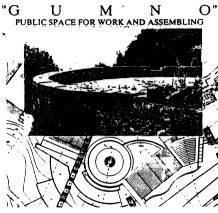
The street is designed as a part of the terrain lined by houses, stairs, retaining walls, and widenings. Located tangential to the street is gumno, space designed as the central motif of the complex, with its high-tech dome being the focal point symbolising the unity between the tradition and technology (Fig.6).
The architecture of the outdoor spaces is characterised by widely cascaded terraces, which are connected by stairs and ramps. All these are built of local unfinished stone blocks with fences in metalwork. The applied cascading of the terrain is derived from the surrounding landscape, which has been similarly formed by local people, over the centuries.
The organic approach is emphasised in the location of the buildings along the same level of the terrain, as well as by the free composition of the complex, and accentuated by the focal point around which all the activities take place.
BIO-CLIMATIC CONCEPT
The basic
premises concerning content, spirit, continuity and specificity of the
new complex are realised by the applied materialisation and with that,
the Centre's distinctiveness, in accord with the heritage and the context,
are achieved.
The whole
complex is planned to have autonomous energy, i. e. that all the needs
for heating, cooling, ventilation, hot water and partly electrical energy,
are covered by the use of new and renewable sources of energy.
With regard
to the fact that the whole complex should be a place for testing various
types of buildings and systems which provide low energy consumption, as
well as for the application of new technologies concerned primarily with
new and renewable energy sources, an attempt has been made to provide solutions
for testing as many alternatives as possible, many of which have already
been proven, both in theory and in practice, but not in our country as
yet.
All the buildings
are designed following the principles of bio-climatic architecture. The
knowledge from this field is applied both in urban design and in architectural
design phases. The buildings in this complex are planned not only for research,
but for experiment purposes as well.
The use of
active and passive solar systems is envisaged, with passive systems being
given priority. In addition, the design proposes using and testing other
renewable sources of energy, such as wind, water, bio-mass, Geo-thermal
energies, etc.
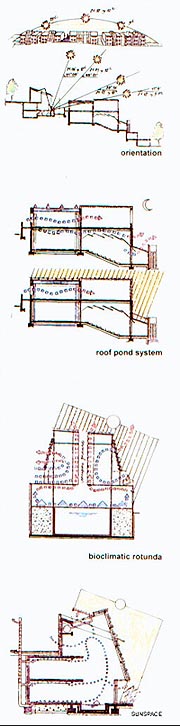
The savings
in energy consumption in the passive system are achieved by: the use of
appropriate building materials which are capable of thermal energy retention;
correct orientation of the buildings on the terrain; large windows with
southern exposure, with the appropriate insulation for the night time intervals;
small windows with the northern exposure; optimal energy strategy for the
building; thermal insulation; thermal zoning of the building etc. In order
to minimise large heat losses during night time, envisaged also is the
flexible thermal insulation. In summer, the building is protected from
solar gain by blinds, vegetation, air circulation, etc.
The following principles have been respected in the design of the complex:
Special attention
has been paid to the function and the design of the conservatories forms,
most of them being exposed to the South. Geometry, materials and sizes
of these conservatories are variable, in order to research the optimal
effects in the given conditions .
In addition
to the traditional wall construction in stone, brick, or cavity walls of
variable construction, alternative walls like Tromb wall, water walls,
and transparent insulation walls, are planned as well.
The water
is used both as insulation and as an "accumulator". Planned are water basins,
thermal siphons, as well as the basins for hot water accumulation.
Great care
is taken in the protection from overheating and overcooling. In addition
to the natural characteristics of autochthonous materials used in the project,
a number of other insulation materials are planned, as well as the protective
vegetation, pergolas, brise-soleil, synthetic and natural material fabrics,
various natural ventilation systems, etc.
All the buildings and installations are interconnected and they correspond with each other both functionally and visually.
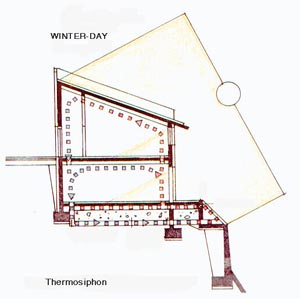
The canopies over the car park, which carry solar batteries, have columns which act as ventilation ducts for the buildings, in areas where heat accumulators are located.
The complexity of the symbiosis of technology and the architectural expression is manifested in the bio-climatic rotunda, at the centre of the whole composition. The heat supply for this part of the building is provided from the circular hot water basin, and it is ventilated by a special system of the ventilation chimney.
The micro-climate in the rotunda is provided by necessary brise-soleil, louvers and vegetation. The rotunda functions as a space for entry, distribution and education for the users, whereby both its form and function are variable. The support for the whole "Acropolis" project is provided by the vegetation layer, which forms cascades in the terrain thereby uniting the landscape and architecture in a unique aesthetic experience.
Institution to be contacted:
The Montenegrin Academy of Sciences and Arts , 81000 Podgorica,
Rista Stijovi}a Str.
No.5.
Coordinator: Momir DJurovic,
Member of the Montenegrin Academy of Sciences and Arts
The designers' aim and intent to prove the possibility of the symbiosis of tradition and modern technology is deemed to be achieved in both functional and aesthetic senses.
Development Program:
Institute of Technical Sciences of the Serbian Academy of Sciences and Arts
Authors : Milan M.Pajevic and Mila Pucar
Conceptual Design:
Institute for Architecture and Town Planning of Serbia
Authors of the conceptual design:
Igor Mari} and Mila Pucar
Bioclimatic Project:
Mila Pucar